

OUR SHOE SOLES
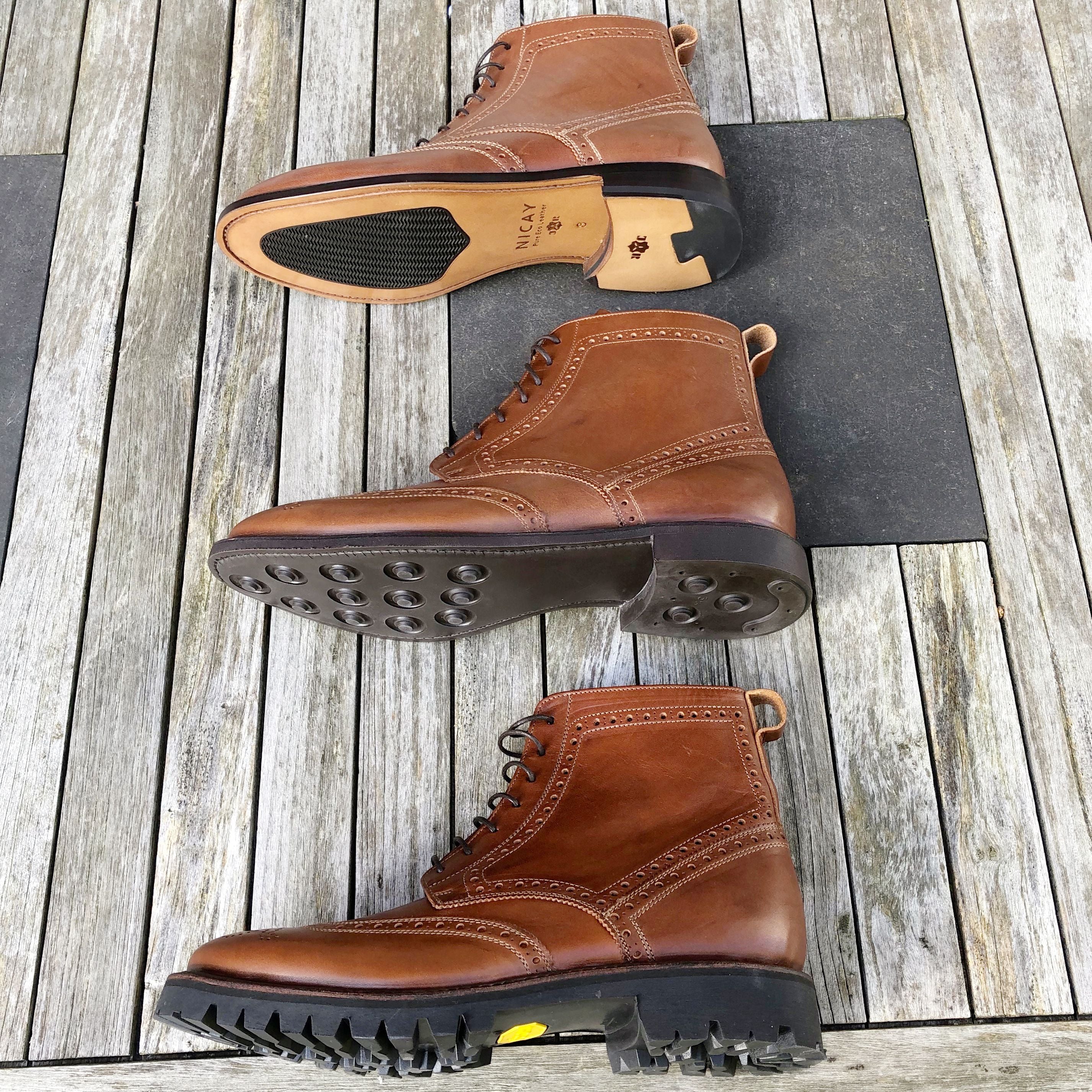
To ensure you enjoy your NICAY shoes and boots for a long time, we use only the best soles and heels, just as we do for the upper and lining leather. Choose the sole that best suits your lifestyle: single or double leather soles, leather soles with integrated non-slip rubber inlay, leather soles with a partial protective sole made of thin rubber, Vibram or Dainite rubber soles. No matter which sole you choose, our soles and their workmanship always allow for professional replacement or repair.

JOH. RENDENBACH OAK BARK TANNED LEATHER SOLES
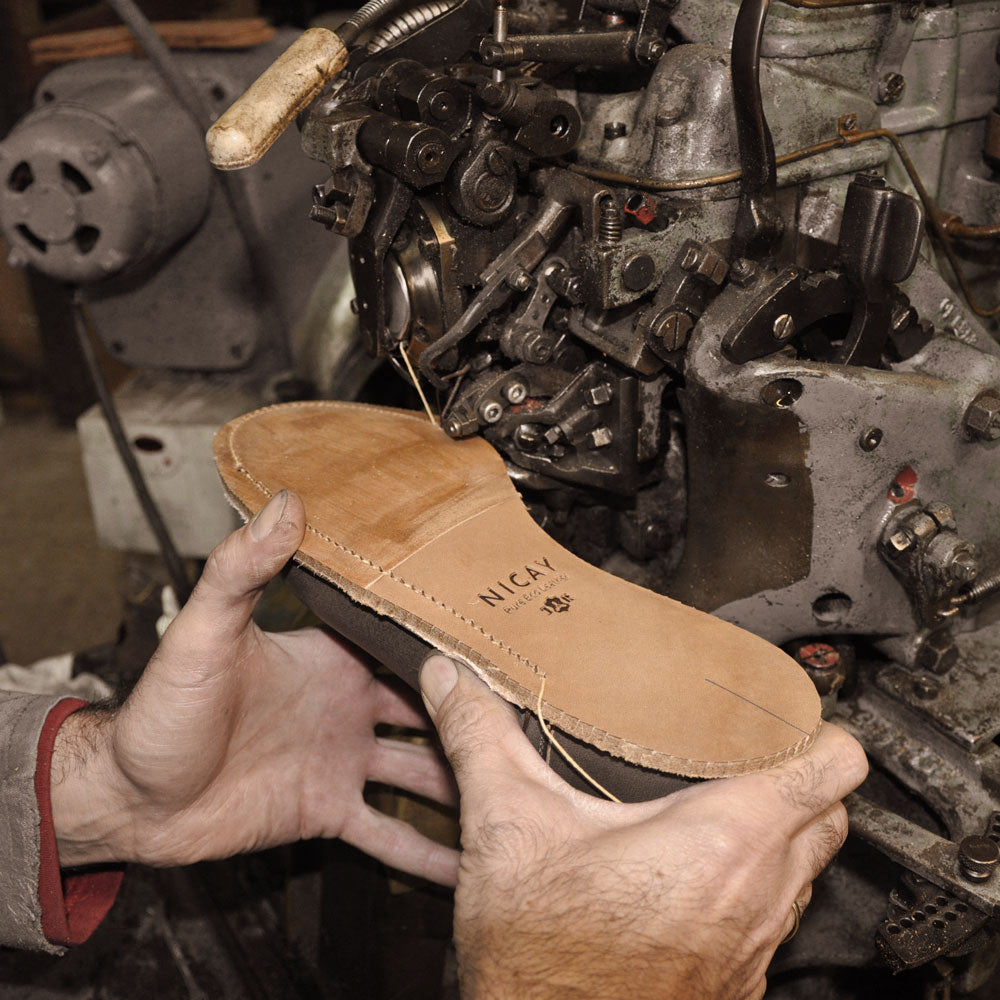
A matter close to our hearts is our collaboration with the Johann Rendenbach leather factory in our hometown of Trier. From there, we source the high-quality leather soles for our shoes and boots. We use these leather soles out of personal conviction, as they meet all the important criteria for us, such as quality, human- and environmentally-friendly production, and an attractive appearance. For over 140 years, the Rendenbach leather factory has been producing particularly skin-friendly leather using the traditional oak bark pit tanning process. Hanns Rendenbach is already leading the Trier-based company in its 4th generation. Traditional oak bark pit tanning is a process that uses compostable tanning agents such as tree bark and fruits. The environmentally friendly and gentle tanning process ensures particularly good skin compatibility, durability, and flexibility of the leather. The leather is completely biodegradable. The natural leather from Joh. Rendenbach is extremely abrasion-resistant, water-repellent, tough yet flexible, offers high wearing comfort, and impresses visually with its warm, wood-like hue. Our most frequently used sole, which we also prefer to wear ourselves, is the Rendenbach "Tonga" sole with a non-slip rubber inlay. A sole for lovers of leather soles who also like it non-slip. To match the sole, we combine it with the Rendenbach "Toplift" heel block, also a combination of leather and non-slip rubber. Of course, you can also get full leather soles from Rendenbach.
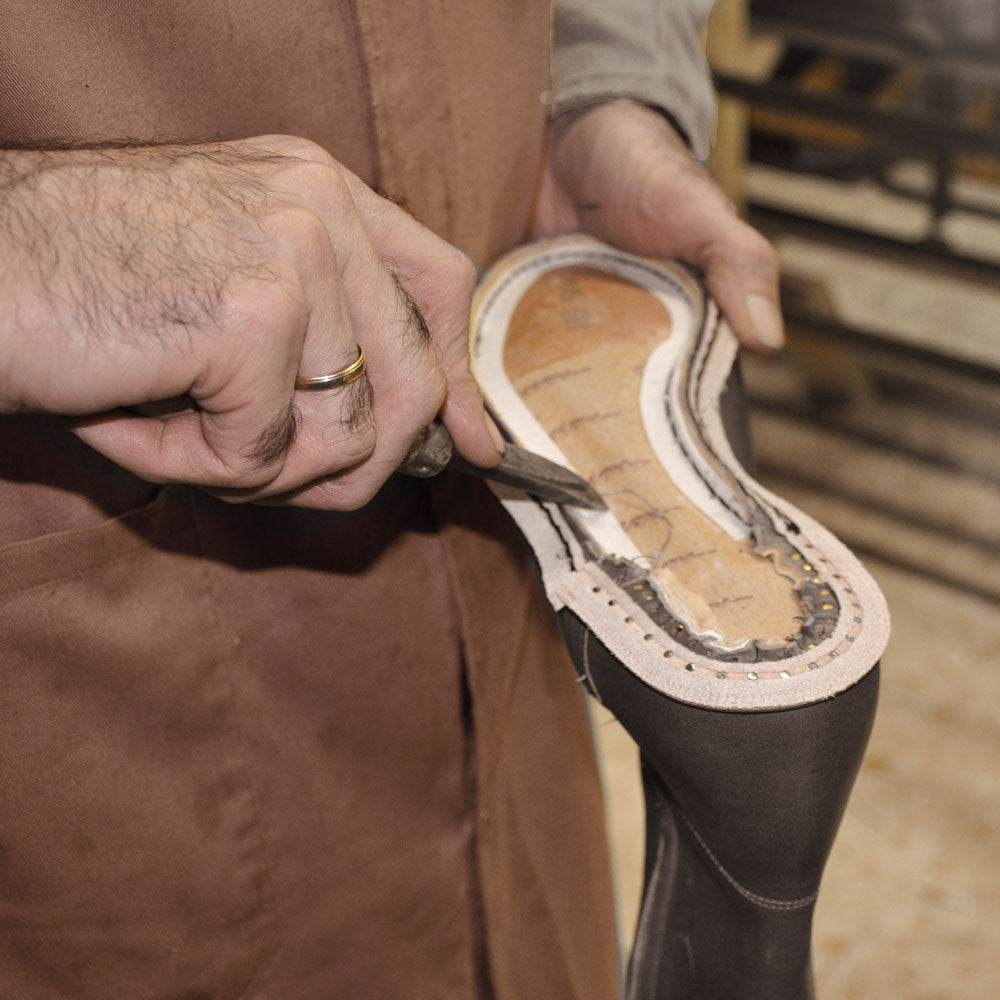
SUSTAINABLE QUALITY SINCE 1871
GOOD THINGS TAKE TIME
When you hold a leather sole from Joh. Rendenbach in your hand, you can't imagine how much work and craftsmanship goes into such a "small sole". Our visit to the Joh. Rendenbach leather factory was impressive in every respect. Since then, whenever we hold a Rendenbach sole in our hand, it fills us with a little awe for all the work and time needed to produce such a sole. The tanning process begins in the coloring section, where a slow pre-tanning of the pelt takes place over a period of about four weeks. The fiber structure of the hide is opened and prepared for the later absorption of the tannins. The coloring section consists of several pits filled with liquors of different concentrations. The frames with the hides are moved daily from one pit of the system to the next. The individual pits are connected in a closed circuit according to the principle of communicating vessels. The second stage of the pre-tanning takes place in the immersion pits. An immersion pit is a pit half-filled with tanning liquor, into which alternate layers of hide material and bark are incorporated. The entire material is then immersed in the tanning liquor. The pelt remains here for about six weeks; after which the process is repeated in a second immersion pit. The actual oak bark pit tanning is a very gentle process. It is carried out in old, approximately three-meter-deep oak wood pits. During the tanning process, the tannins from the bark are integrated into the protein structure of the hide, ensuring its preservation and cross-linking. For traditional oak bark pit tanning, nature provides the most important bark components, including, as with the vegetable-tanned upper and lining leathers we use, oak, spruce, and mimosa bark, as well as valonia fruits.
LEATHER SOLES AND HEELS WITH A THIN RUBBER HALF-SOLE
Among the most discussed topics is the question of whether leather soles should be covered with additional rubber protection or not. Our Goodyear-welted shoes and boots are available with or without rubber protection. The most common arguments for an additional rubber sole include that the leather sole is protected from moisture, the feet stay dry, the sole is more slip-resistant than the leather sole, the welt seam is protected, and the wear of the leather soles is reduced. Since the rubber protective sole is relatively thin at 2mm, it hardly detracts from the elegant appearance. If you delve deeper into this topic, you will encounter just as many counter-arguments, including that the shoes feel stiffer and harder when walking compared to a pure leather sole, the shoe's static is altered, the welt seam could be damaged when sanding the leather sole, the foot can no longer breathe properly, or that the elegant appearance of the shoe suffers. Comparing these positions, it is still difficult to make a decision. Even experts do not agree here, so we believe you should make this decision individually according to your needs. Surely it makes a difference whether you walk to the office on foot in wind and weather over gravel and cobblestones, or whether you drive to the door by car. Personally, I have opted for the Rendenbach Tonga sole, a leather sole with a centered rubber inlay, plus the heel block Toplift, also a combination of leather with a corner of non-slip rubber. In addition to the beautiful appearance of the sole, the rubber inlay is non-slip, the leather sole is absolutely flexible, and the walking feeling is unsurpassed. Except for a few weeks a year, I wear these soles all year round. In snow and ice, a pair of shoes or boots with Vibram soles then provides the best service.
DAINITE SOLES
In addition to Goodyear-welted shoes, leather soles are still considered the first choice for upscale business and special occasions due to their elegant appearance. The Dainite rubber sole is a small exception here: Due to its thickness of only 5mm, the Dainite sole looks almost as elegant as a leather sole. Especially in wet weather, the Dainite sole offers surefootedness on slippery surfaces and protects against wetness and cold. Dainite soles are made of solid rubber and are very durable. So, is it better to have leather soles or Dainite soles? Opinions differ here. Despite all the advantages of Dainite soles, one thing still holds true today: You should never wear shoes with rubber soles with a tuxedo.
VIBRAM RUBBER SOLES
The distinctive feature of Vibram, the world's leading manufacturer of high-quality rubber soles, is the yellow octagon. Vibram is a trademark of the company of the same name for particularly abrasion-resistant rubber shoe soles and is arguably the best-known manufacturer in this field. The soles are primarily used on mountaineering, trekking, and hiking boots. They offer excellent cushioning properties, good grip, and extreme slip resistance. The first Vibram sole was invented in 1935. In 1935, six mountaineers died on Punta Rasica in a tragic mountain accident due to unsuitable footwear. Vitali Bramani, also a mountaineer, took this as an opportunity to research new shoes with rubber soles that would be better suited for alpine terrain. With the help of the Pirelli company and Charles Goodyear's vulcanization technology, he created a water- and winter-resistant rubber sole, which he patented in 1937. The rubber compound is crucial for the longevity of a sole. The harder the rubber compound, the more abrasion-resistant the sole is. Vibram produces extremely durable soles that are made for tough use. The durability of the sole is tested during intensive field tests during development. Vibram produces a variety of different rubber compositions, which meet the specific requirements of the respective sport. There is hardly a discipline for which Vibram has not yet produced a suitable sole. The spectrum ranges from water sports, climbing, trekking and trail running to cycling and motor sports. Right down to the sole for normal leisure shoes, everything is included. No matter which Vibram sole you use, these soles are characterized by maximum wearing comfort, safety, and the best grip on the ground.